Let the labor wars begin.
The MLB players' association lobbed the opening salvo in collective bargaining agreement negotiations Wednesday, proposing an increase in the minimum salary, the elimination of the qualifying offer in free agency, and a new "competitive integrity tax" to incentivize spending.
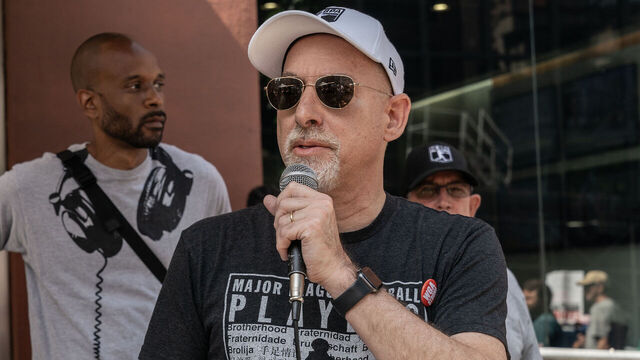
"Our goal is to preserve and improve baseball's market system, rewarding competition on and off the field," MLBPA interim executive director Bruce Meyer said in a statement. "The players' proposals provide increased revenue sharing initially guaranteeing every small market club a minimum of $240 million in revenue every season.
"This enhanced revenue sharing includes added protections to ensure clubs prioritize winning over profiteering. Ultimately, our proposals are designed to build upon the incredible momentum and popularity of our sport worldwide."
A major part of the union's proposal is a competitive integrity tax, which would be paid by teams that fail to meet minimum spending requirements. The goal is to incentivize spending, especially from smaller-market teams that have traditionally stayed away from top-tier free agents.
If implemented as it's been proposed, the competitive integrity tax would start at $150 million. Meanwhile, the competitive balance tax threshold would then be bumped up to $300 million, a $56-million increase from last season, according to Evan Drellich of The Athletic. Ultimately, the CBT threshold would increase to $360 million by 2031.
The MLBPA also sought to help lower-revenue teams by increasing revenue sharing to a minimum of $240 million every year - provided that the money be used strictly to improve the on-field product.
Additionally, the union proposed an expansion of arbitration eligibility, eliminating the qualifying offer, and an expansion of rules to both crack down on service-time manipulation and stop teams from openly tanking. It also proposed that players who are at least 30 years old become eligible for free agency after five years of arbitration rather than six. The minimum salary would also rise to $1.5 million starting next year.
"We all see the momentum in our game. Amazing players and incredible fans," Baltimore Orioles pitcher and MLBPA executive subcommittee member Chris Bassitt said. "Attendance, viewership, interest - by any measure you want to use, our game is moving in a positive direction. We've put forward proposals designed to continue that trend. Support, incentivize, and reward clubs who are committed to competing, especially small-market clubs. Compensate players fairly for the work they are doing."
MLB is expected to offer a counterproposal Thursday, according to Drellich. It's unclear what the league will offer, although MLB is widely expected to push for a salary cap during negotiations. Baseball is the only major North American sports league that continues to operate without some form of a cap.
"We appreciate the union making a set of proposals, and we look forward to continuing the bargaining process and working towards solving the competitive balance problem our fans are telling us needs to be addressed," MLB spokesman Glen Caplin said in a statement. "We understand their proposals are designed to benefit players. Unfortunately, they do not address and, in fact, exacerbate the competitive balance problem our fans are telling us we must address.
"The MLBPA's proposal would reduce the amount transferred to lower-revenue clubs, weaken the competitive balance tax, and lead to even more payroll disparity than exists today. For example, under the union's proposal, the Dodgers would pay less in luxury tax payments, giving them an additional $70 million to spend on payroll."
Baseball's current collective bargaining agreement will expire Dec. 1 at 11:59 p.m. ET. MLB is expected to lock out the players if a new agreement isn't in place by that time, as it did five years ago.
The contentious 2022 CBA negotiations nearly led to games being canceled before a last-minute agreement in March salvaged the 162-game season. MLB hasn't lost games to labor issues since the 1994-95 strike.